The Vermont Process-Based Restoration Network is hosting events and workshops, and sharing resources on techniques for restoring riverscapes
We are excited to announce the launch of the Vermont Process-Based Restoration Network.
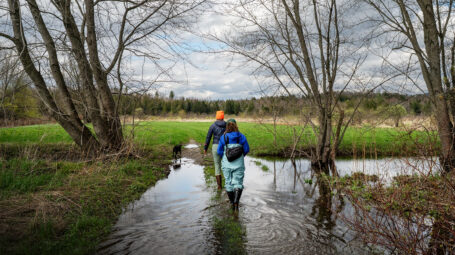
Building flood resilience does not always have to be complicated or expensive. Low-tech, process-based solutions can improve water quality and flood resilience while restoring diverse habitats for native plants and wildlife.
Together with partners from across the state, we are strengthening the community that can help restore Vermont’s riverscapes by mimicking natural features like beaver dams and old-growth forests.
“We envision a Vermont with rich, complex river systems full of elements like meandering and multithread channels, floodplain forests, meander wetlands, and headwaters, where flood waters slow and spread instead of rushing madly downslope,” said Allaire Diamond, our Ecology & Restoration Program Director.
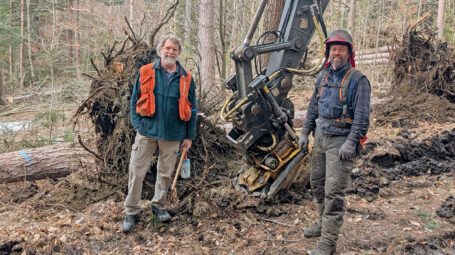
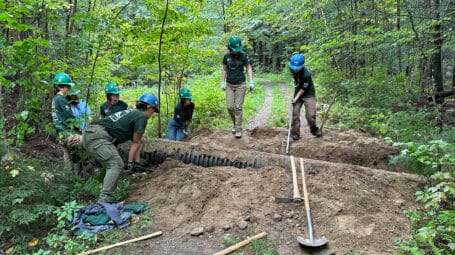
The Vermont Process-Based Restoration Network promotes restoration techniques that are based on natural processes, and can often be completed using hand tools rather than heavy machinery, making them less costly than other approaches. The network is designed to support natural resource professionals in Vermont who are interested in learning about and implementing these types of restoration projects in their watersheds.
As it develops, the network will become a space where people working on these kinds of projects can come together to learn skills, share successes and challenges, navigate regulatory requirements, and connect with other contractors, consultants, and project managers.
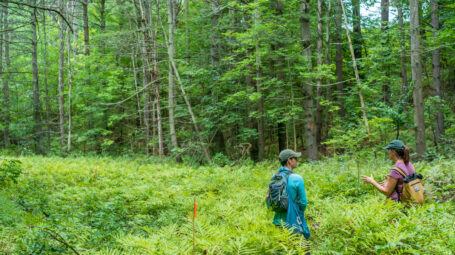
Allaire said the group held in-field workshops this past summer, including educational events. Those interested in learning more and hearing about future events can visit vlt.org/vtpbrn or contact VLT’s Elijah Schumacher at Elijah@vlt.org.
Network includes watershed groups, environmental organizations, and state and federal entities
After a yearlong design process, the network kicked off with a virtual meeting in the summer. Nearly fifty people from state and federal entities, watershed groups, environmental non-profits, and environmental consultants tuned in for presentations on restoration approaches such as beaver dam analogs (BDAs), strategic wood addition (SWA), and brush packing.
The network is facilitated by VLT’s Elijah Schumacher and has a Steering Committee consisting of Shayne Jaquith of The Nature Conservancy, Shawn White of the Watershed Forestry Partnership, and VLT’s Allaire Diamond.
The Design Team includes specialists from Orleans County and Franklin County Natural Resource Conservation Districts, Memphremagog Watershed Association, Vermont Natural Resources Council, Trout Unlimited, and VLT.
Other partners — including local watershed organizations, water resource and forestry professionals, and educational institutions — are also participating.
Low-cost, community-scaled methods that enhance natural processes
Process-based restoration (PBR) is a suite of techniques that typically involve adding locally sourced wood and vegetation to stream and wetland systems. The intention is to initiate or accelerate natural processes that improve how streams and their associated floodplains and wetlands, together referred to as riverscapes, function.
These techniques help streams and rivers slow, spread, and store water more effectively. This, in turn, supports cleaner water, richer and more diverse habitat for wildlife, and greater resilience to flooding and climate change. The added materials eventually break down and become part of living and evolving ecosystems.
PBR was pioneered in the American west, originally to improve salmon and trout habitat. As the benefits of such work became clear, interest spread across the US and as far as France, and advanced techniques were developed. PBR practices are now used to address a host of riverscape challenges, including degraded fish habitat.
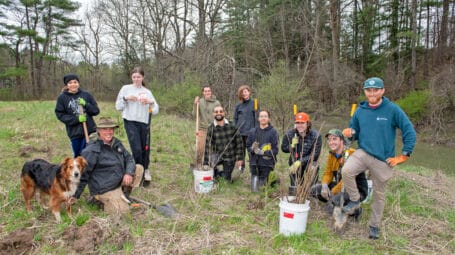
The approach is highly suitable for small-scale efforts at the local and community level, and can be implemented with the help of community members and landowners.
“We have been collaborating with partners and landowners to restore streams and have seen the effectiveness of these methods,” explained Allaire. “We want to share our learning with the wider community of natural resource professionals working on flood resilience in Vermont, and also learn from them. By working together we can increase the pace of process-based restoration and help Vermont’s riverscapes return to the rich, complex ecosystems that make our communities more resilient.”