Can't find what you're looking for? Please contact us.

Vermont Process-Based Restoration Network

Welcome to the VTPBR Network

The Vermont Process-Based Restoration (PBR) Network is a diverse collaborative of natural resource practitioners working and learning together about process-based restoration practices. The network provides a space for people working on these project types to come together to discuss successes and challenges, navigate regulatory realities, and connect with contractors, consultants, and project managers who might be available to partner on the next project. For upcoming events and meetings, contact Elijah Schumacher.

Contact Elijah

Upcoming events & PBR in the news

Event: Strategic Wood Additions in Norton, VT

Jud Kratzer of the Vermont Department of Fish and Wildlife will be doing Strategic Wood Additions on three streams in Norton, VT this summer. The work should begin in June and end in August. The crew will be working most Tuesdays and Thursdays during that time. They have the help they need, but people are welcome to watch and learn. If anyone wants to join the crew, they can contact Jud and discuss logistics: jud.kratzer@vermont.gov

In the news: Vermont’s brook trout population

Vermont’s state fish is ‘thriving’ despite national population decline | Vermont Public

What is Process Based Restoration?

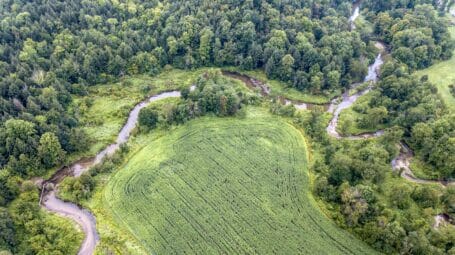
Process-based includes a range of approaches that initiate or accelerate natural hydrologic, geomorphic, and biological processes leading to improved stream and floodplain conditions. PBR practices are adaptive over time to environmental feedback with the goal of encouraging a self-sustaining, dynamic riverscape ecosystems. PBR approaches generally involve adding wood and other natural materials to stream and wetland systems. Methods fall on a spectrum scaled to restoration goals and stream/watershed size, and include beaver mimicry (Beaver Dam Analogs or BDAs), Post-Assisted Log Structures (PALS), Strategic Wood Addition (SWA), brush packing to restore headwater wetland areas, and other techniques.

PBR is different from engineered restoration efforts in that PBR typically uses low-tech, low-emission, and hand-scaled solutions with natural materials that are meant to eventually break down and become part of living and evolving ecosystems. While engineered, fixed solutions are appropriate in certain scenarios where there is a need to stabilize a system (to protect infrastructure, for example), PBR invites us to carefully consider the needs of the site. Rather than automatically turning to expensive solutions with lots of concrete and heavy machinery, whenever possible, PBR opts for lighter-touch, lower-impact solutions where nature does the work for us.

What are the benefits of PBR?

PBR offers a practical, low-impact approach to improving the health and resilience of rivers and floodplains by working with — rather than against — natural systems. Using low-tech, low-carbon methods and locally sourced materials like wood and vegetation, PBR techniques help rivers slow, spread, and store water more effectively. This, in turn, supports cleaner water, richer and more diverse habitat, and stronger resilience to flooding and climate change.

Unlike heavily engineered solutions, PBR encourages dynamic, self-sustaining ecosystems that adapt over time, often at lower cost and with fewer environmental impacts. By harnessing natural processes, PBR not only restores ecological function but also creates more flexible, enduring solutions for landscape stewardship. In short, PBR:

  • Enhances a river’s capacity to store, slow and spread water
  • Maintains and improves water quality
  • Restores more diverse habitat for native plants and wildlife
  • Improves flood and climate resiliency

Common PBR Approaches

1. Beaver Dam Analog

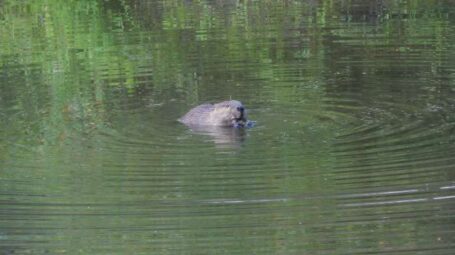
BDAs are hand-built structures that mimic and promote the processes of beaver dam activity. BDAs are permeable structures that can either span or intrude into the channel, constructed with a mixture of woody debris and fill material to promote temporary ponding of water. These can include postless, post-assisted, or post-and-wicker line BDAs. BDA’s are often built using live willow cuttings which can resprout given enough light and water. In Vermont where willow is often not as available as it is in much of the west where this technique was developed, we frequently need to get creative and explore the materials that are available on the local landscape.

2. Post-Assisted Log Structure

PALS are hand-built structures that mimic and promote the processes of wood accumulation. Woody material of various sizes is pinned together with untreated wooden posts that are driven into the substrate. These can include bank-attached, mid-channel, or channel-spanning PALS.

3. Strategic Wood Addition

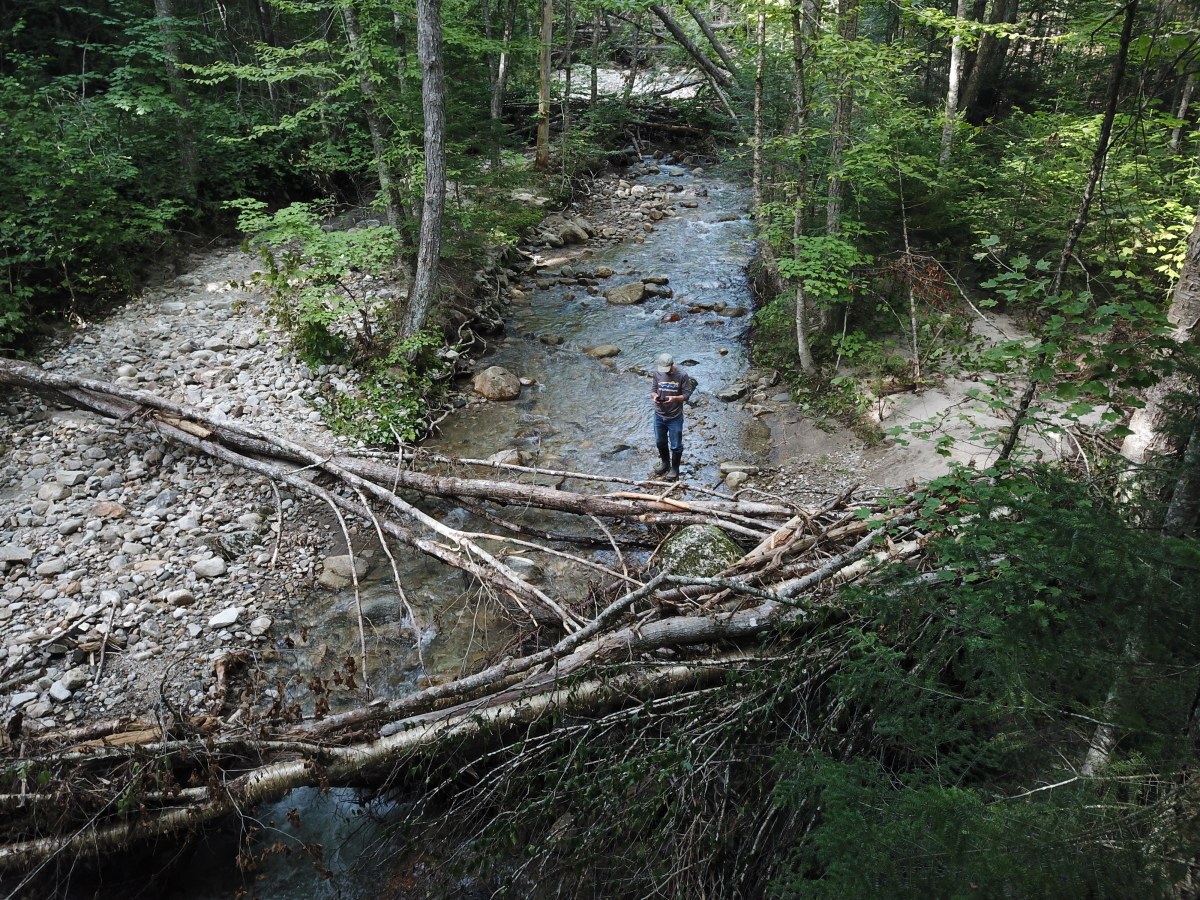
Strategic wood addition (from the Vermont Strategic Wood Addition Handbook) includes a variety of techniques that can be used to securely add large woody material to streams. In most cases, riparian trees are felled directly into the stream using a chainsaw, although trees could be transported to the stream from upland sites. Strategic wood addition includes “chop-and-drop” and “chop-and-grip” techniques. “Chop-and-drop” is a technique that can be used on streams where the riparian trees are large relative to the channel. In these small streams, manipulation of the downed trees is not necessary to stabilize them. In larger streams, a grip hoist is used to position downed trees in secure locations so that they will be less likely to move during high flow events, hence the “drop-and-grip” method.

4. Brush Packing

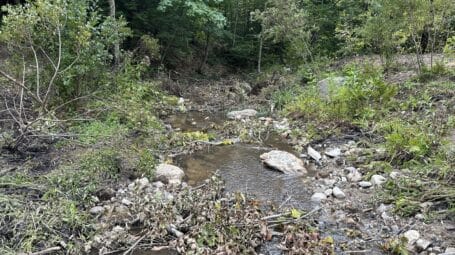
This low-tech, cost-effective technique puts large quantities of “slash” – material from vegetative management – toward filtering sediment, reducing erosion, slowing headcut travel upstream, improving habitat, and improving the carbon- and water-sequestering soil sponge of upland landscapes. This is an iterative process and practitioners should revisit sites regularly to check on progress and add more material.

Interested in joining the network?

Contact Elijah

Who we are

Facilitator

close up photo of young man wearing baseball cap and red plaid shirt with pine woods behind. VermontElijah Schumacher is Vermont Land Trust’s Watershed Specialist. He can be reached at elijah@vlt.org


Steering Committee

pic of man wearing hatShayne Jaquith is The Nature Conservancy in Vermont’s Watershed Restoration Manager. He can be reached at shayne.jaquith@tnc.org


Shawn White is the Watershed Forestry Partnership’s Watershed Forestry Partnership Coordinator. She can be reached at shawn.white@uvm.edu


Allaire Diamond portraitAllaire Diamond is Vermont Land Trust’s Ecology and Restoration Program Director. She can be reached at allaire@vlt.org


Network Design Team

Dorothy Kinney-Landis is Franklin County Natural Resource Conservation District’s Natural Resources Planner. She can be reached at dorothy@franklincountynrcd.org



Erin Rodgers is Trout Unlimited’s Eastern Region Program Manager. She can be reached at erin.rodgers@tu.org


Jud Kratzer is a Fisheries Biologist for the Vermont Department of Fish and Wildlife. He can be reached at jud.kratzer@vermont.gov



Karina Dailey is the Vermont Natural Resources Council’s Science and Restoration Director. She can be reached at kdailey@vnrc.org


Lauren Weston is Franklin County Natural Resource Conservation District’s District Manager. She can be reached at lauren@franklincountynrcd.org
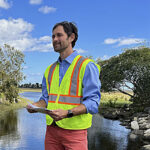


Matt Thorne is The Nature Conservancy in Vermont’s Director of Freshwater & Community Resilience. He can be reached at matthew.thorne@tnc.org


Patrick Hurley is Memphremagog Watershed Association’s Watershed Project Manager (and principal at Windenwater LLC). He can be reached at phurley@mwavt.org


Ted Sedell is the Orleans County Natural Resource Conservation District’s Riparian Lands Program Manager. He can be reached at ted.sedell@orleanscountynrcd.org



Tyler Miller portraitTyler Miller is Vermont Land Trust’s Executive Vice President of Programs. He can be reached at tyler@vlt.org