Can't find what you're looking for? Please contact us.

Resilient riverside

3 min read / March 9, 2026

When heavy rains swell Vermont’s rivers, that extra water needs somewhere to go. 

Floodplains hold and absorb flood waters more safely, minimizing damaging impacts downstream. But when artificial barriers prevent rivers from being able to reach those critical storage zones, flood damage and water quality are worse.
Creating space for the river

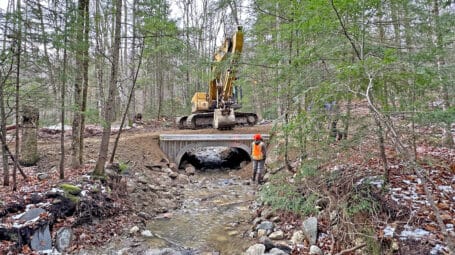
Last summer, we removed an 800-foot-long earthen berm — a long, narrow pile of earth about 2 feet high — that had historically run along the Winooski River in Marshfield.

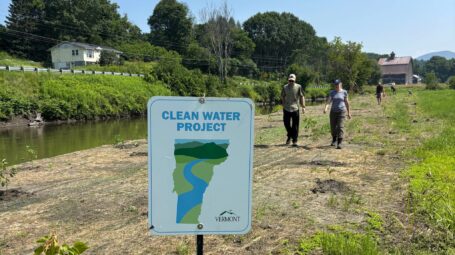
We then planted trees in the area to jump-start the development of a riverside forest that can slow, hold, and filter water.

Now, when waters rise, the Winooski can expand more easily and safely into its floodplain, helping keep the watershed healthy and phosphorus out of Lake Champlain.

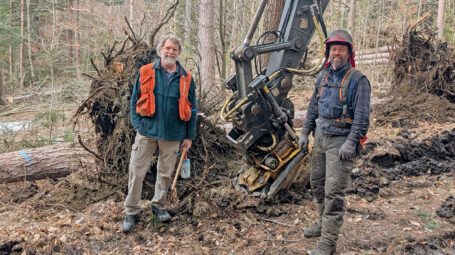
Photo: An excavator at work during the berm removal along the Winooski River.

Credit Marie Maclay

Layered conservation efforts for flood resilience

Located near the Martin Covered Bridge and John Fowler Road, the site is visible from Route 2. The berm had been in place for many decades, built to limit flooding into the adjacent farm field.

The Winooski River continued to flood the field regularly, including during the historic floods of 2023 and 2024.

Some years before, we had prioritized the riverside area for conservation. In 2021, we partnered with the Vermont Department of Environmental Conservation to protect nearly 20 acres with a River Corridor Easement. That means the land along the river is permanently set aside so a band of forest can regrow over time, and the river has space to move.

But the berm was still in place, and the area needed to be restored.

Photo: Floodwaters in 2024 covered the now-removed berm. Photo by Marie Maclay.

Designing for river health and floodplain forest

We assessed the needs and designed a project for river conditions at the site with consultants Fitzgerald Environmental Associates.

In June 2025 a construction crew from Marshfield Tree Service & Logging spent two days removing the berm and preparing a one-acre riverside buffer area.

Photo: Designer Rodrigue Spinette from Fitzgerald Environmental Associates and Mike Baril from Marshfield Tree Service looking at project plans pre-construction.

Planting a forest

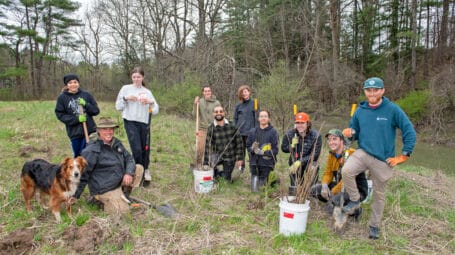
Partners from Friends of the Winooski River joined the effort, planting a mix of wetland and floodplain plant seeds as well as 400 trees and shrubs.

As they grow, these plantings will jump-start the kind of floodplain forest that rivers — and the many fish and animals that depend on them — need.

A forest for water, brook trout, and wood turtles

As Michele Braun, Executive Director of Friends of the Winooski River, explained:

“Flooding will be reduced in a vulnerable area, and sensitive species like brook trout and wood turtle will have improved habitat on land and in the river.

Photo: Michele Braun at a tree planting on conserved land in 2022.