Can't find what you're looking for? Please contact us.

Restoring our riverscapes

10 min read / September 23, 2026 / By Laura Hardie

The vision for Vermont’s waterways and how we get there

Humans have long altered our environment to carve out spaces for living, farming, travel, and community. Over centuries, we cleared forests, drained wetlands, and re-shaped rivers. Now, as more intense floods and droughts hit Vermont, we’re facing the unintended consequences of those actions.

To reconcile these historic and modern realities, VLT is integrating ecological restoration into its decades-long work of land protection to promote resilience.

Altered state: Vermont’s streams and rivers

Humans have long altered our environment to carve out spaces for living, farming, travel, and community. We cleared forests, drained wetlands, flattened uneven ground, re-shaped rivers, and dug materials out of the earth. Over centuries, landscapes slowly went from wild to managed.

Now, as more intense floods and droughts hit Vermont, we’re facing the unintended consequences of those past actions. Roughly 75 percent of the state’s streams and rivers have been so altered that they can no longer function naturally, according to state data.

They’ve been straightened, deepened, dammed, and cut off from their floodplains. When massive storms hit, the water often has nowhere to go but into our communities, causing devastation.

“That alteration of our aquatic ecosystems has made flooding much more intense and frequent, worsened water quality, and eradicated habitat for many species,” says Matthew Thorne, The Nature Conservancy’s director of freshwater in Vermont.

We are learning that the fix isn’t more engineering to control where water goes and how waterways behave. It’s giving rivers back what they’re missing: the ability to connect to their floodplains and broader riverscapes. Connected floodplains and rivers improve water quality, flood resilience, and ecological integrity.

The Vermont Land Trust helps reconnect riverscapes in many ways. All new conservation easements include special protections for all streamside forest, and river corridor easements specifically provide space for rivers to move naturally in their valleys. In addition to these legal protections, VLT wants to actively jump-start the ability of rivers to regain their natural structure and processes. Two of the simplest, most effective tools for physically giving rivers and streams what they’re missing are adding wood back into streams and inviting beavers back to the landscape.

Wood and beavers slow water down, allowing sediment to settle rather than wash downstream, and rebuild the habitat fish and other species need.

“Most streams and rivers in the Northeast do not have enough wood in them to be healthy,” Matt says. “It’s like a body without bones. It needs bones.”

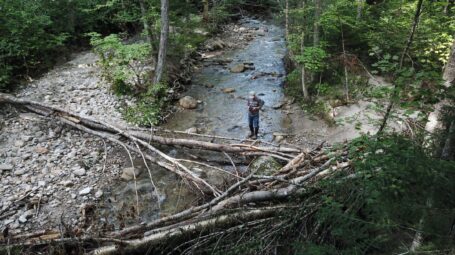
Photo: The Otter Creek watershed in Dorset, VT, where VLT removed a dam in 2024. Credit Fluid State Consulting.

Why our floodplains are broken

Long before Vermont was tamed by roads, dams, and fields, it was swampier, messier, and boggier — in a beautiful way. Shaped and maintained by a robust beaver population, the landscape had a greater capacity to absorb, slow, and filter water.

Then came the fur trade. By the mid-1800s, beavers were all but gone from the state. “A lot of our historic spaces in the lower parts of the watersheds were built in former beaver habitat,” says Allaire Diamond, VLT’s restoration and ecology program director. “Settlers understandably were drawn to these flat, fertile areas.”

By the 1940s and ’50s, people were also shaping waterways to make them clean, narrow, fast-moving, and tidy at the edges. Often funded with federal dollars, this reshaping increased in the mid-20th century. It helped define areas for human travel, farming, and settlement. It also forced rivers and streams into constrained channels with almost no flexibility. These narrow, defined rivers became part of the Vermont aesthetic.

“The perception of a stream being a very neat, contained, linear channel is just really not natural,” Matt says. “It’s an invented image, at least in Vermont.”

A stream naturally swells and spreads with rain and may even change its path over time, or flow via multiple channels. When rising waters can’t spread into the wider riverscape, they rush downstream with greater force. Increased rain and damaging floods, such as 2011’s Tropical Storm Irene and subsequent flood events, demonstrated how that force can wreak havoc on communities.

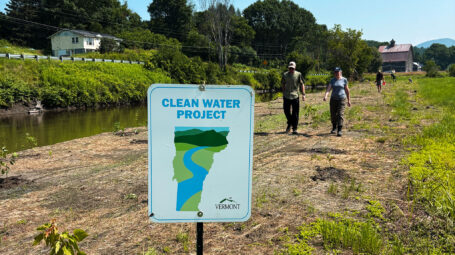
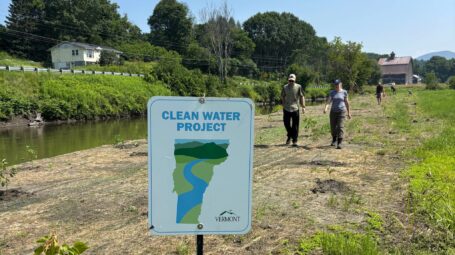
Photo: The Lee River on a conserved farm in Jericho, where VLT has been working to reduce erosion and flood risk by encouraging the growth of shrubs and trees along the banks and in the surrounding floodplain.  

“Most streams and rivers in the Northeast do not have enough wood in them to be healthy. It’s like a body without bones."

— Matthew Thorne

Enhancing land conservation through restoration

VLT has spent the last decade developing an approach that can reconcile these historic and modern realities. “We conserve key places in our watersheds and restore them,” Allaire explained. “This can soften the impact of floods, maintain clean water, and improve habitat.” VLT is integrating ecological restoration into its decades-long work of land protection to promote resilience.

While VLT’s core conservation work has long helped people protect their farms, working forests, and community green spaces, by the early 2000s that focus had expanded to include watersheds. In alignment with statewide efforts to improve water quality, the organization began adding special protections for wetlands, riverside land, and other sensitive areas. VLT has since partnered with Vermont’s Department of Environmental Conservation and with farmers to protect river corridors and wetlands on dozens of farms with state and federal funding.

As VLT staff supported more farmers and landowners in taking care of wetlands and streams on their conserved lands, they began to see an opportunity: the restoration of natural processes. VLT’s restoration efforts grew directly from our ecological protection work, which is based on an understanding of Vermont’s natural communities.

“It’s really helpful to know what a degraded landscape could become, if restored,” Allaire said. For example, a frustratingly wet farm field could become a thriving Northern White Cedar Swamp.

“Conserving a degraded watershed is not enough on its own,” Matt echoed. “Because some of those systems are just going to continue to deteriorate. They have to be restored and reconnected.”

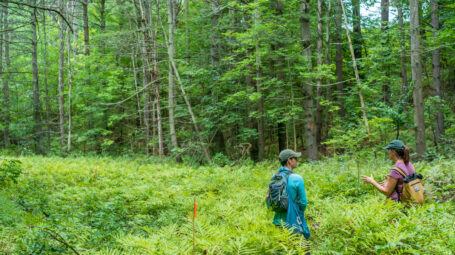
Photo: VLT’s Allaire Diamond and Kyle Birrer at the Lee River site during a planting and floodplain restoration workday. 

Along, Across, Within: VLT’s new riverscape restoration toolkit

Today, three people make up VLT’s ecology and restoration team. Allaire and her new team members — Restoration Project Manager Kyle Birrer and Watershed Specialist Elijah Schumacher — evaluate sites using a new framework they’ve developed called ‘Along, Across, Within.’ They ask a series of questions about the riverscape, which is the whole system around a stream, not just the water.

Is there forest along the bank to shade the stream and slow floodwater? Are streambanks reinforced with rocks and concrete, limiting floodplain access? Are dams across the stream blocking natural flow and sediment movement? Are culverts or bridges big enough to avoid constricting the water’s flow? Is there enough wood within the channel to provide the structural ‘bones’ that slow water and shelter fish and other wildlife?

Based on this evaluation, the team can design the restoration project best suited to the site. VLT has planted trees in streamside buffer zones, replaced culverts, established floodplains, removed dams and berms, and added woody structure.

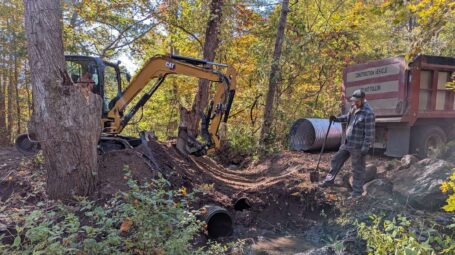
That last piece, adding wood to put back the ‘bones,’ is the heart of process-based restoration (PBR), which is VLT’s newest restoration initiative. Rather than engineering a ‘form-based’ solution that will stay fixed and static into the future, crews jump-start a river’s natural processes with wood and other materials that are intended to break down and become part of a living system over time.

Heavier, engineered fixes still make sense for protecting a bridge or other infrastructure, but where it fits, this lighter-touch approach is an excellent option.

“Traditionally, floodplain restoration projects involved big yellow machines,” Matt says. “Hundreds of thousands or millions of dollars to restore short stretches of floodplain. Now they’re likely to involve volunteers.”

“It’s really helpful to know what a degraded landscape could become, if restored."

— Allaire Diamond

Putting the ‘bones’ back: Process-based restoration

The PBR toolkit is low-cost, low-tech, and scales with the stream. Beaver dam analogs — small structures resembling beaver dams, but hand-built by humans — are suitable for small headwater streams. Strategic wood addition — dropping in whole trees and anchoring them where needed — works for big streams and small rivers up to about 20 feet wide.

Strategic wood addition alone has helped grow the number of brook trout in northeastern Vermont by an estimated 83,000 over the past 13 years, according to the Vermont Fish and Wildlife Department.

With these practices, a stream that’s been straightened and dredged for a century can slow down, spread out, and reconnect to its surrounding riverscape.

“By putting wood in there, leaves, sticks, and sediment gets stuck behind it, and the streambed starts to rise and meet the floodplain,” Matt explains.

The beaver dam analogs are one piece of a related restoration strategy VLT calls ‘Inviting Beavers Back,’ which also includes designing easements that leave room for beaver wetlands, sharing the benefits of beavers with landowners, and installing coexistence devices, like pipes and fencing, that limit flooding so we can share space with beavers.

Beavers create dynamic systems that support resilience and habitat,” Allaire says. “And they do it for free, and better than we ever could.”

Photo: Crews can hand-build small structures resembling beaver dams, a.k.a. beaver dam analogs. 

Starting at the source pays dividends downstream

Allaire says restoration practices, especially in headwaters — the starting point of a river or stream where water first begins to flow — pay dividends downstream by slowing the flood pulses that do the worst damage to towns below.

VLT is uniquely positioned to implement headwater restoration work. “Our conservation easements include land in the headwaters of every watershed in the state,” Allaire says. “If we can keep water in those places for longer, that’s going to amplify across the landscape and prevent big pulses of water going down into the larger rivers.”

The math favors small streams, too. A 50-foot buffer, she says, “is a lot more significant on a smaller headwater stream” than the same buffer along a river as big as the Winooski, and headwater work is often cheap enough to do by hand.

VLT’s dam removal work centers on headwaters too. The land trust has removed decaying dams in the headwaters of the Otter Creek, Lake Champlain’s Malletts Bay, and the Missisquoi River, and is planning projects in other watersheds. These efforts, while small in scale, are cost-effective and can cumulatively deliver significant impact.

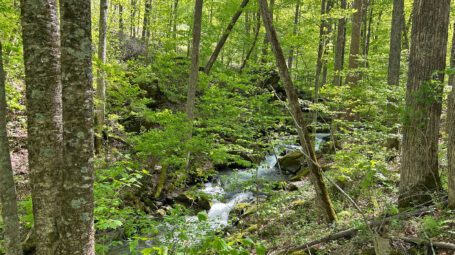
Photo: Beaver dam analogs like this can jump-start a river’s natural processes by adding wood and other materials that are intended to break down and become part of a living system over time. 

Working in community, towards a more resilient landscape

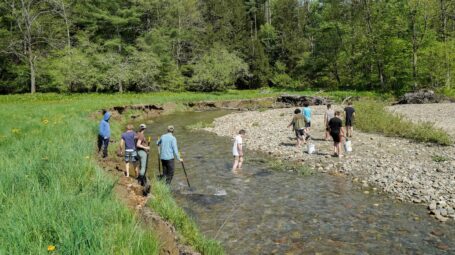
The PBR approach is highly suitable for small-scale efforts at the local and community level, and can be implemented with the help of volunteers. “Building these beaver dam analogs is really fun for volunteers,” Matt says, “and some of the advanced techniques like felling trees into the stream can be a nice source of additional revenue for foresters and loggers.”

To increase the pace of restoration efforts across Vermont, VLT helped launch the Vermont PBR Network this spring. The first meeting drew nearly 50 practitioners. “We hope the network will become a space where people can come together to learn skills, share successes and challenges, and help Vermont’s riverscapes return to the rich, complex ecosystems that make our communities more resilient,” said Allaire.

VLT’s restoration community continues to grow. Landowners and volunteers participate in buffer plantings; youth conservation crews build beaver dam analogs; ecological assessment, design, and project funding brings together watershed groups, state and federal entities, engineers, other nonprofits; and passionate donors support new initiatives.

The ultimate vision is a spongier Vermont landscape, with broader swaths of riverscape that can absorb the increasingly heavy rain and retain water in times of drought. Spongy landscapes support wildlife and stop phosphorus from flowing into Lake Champlain.

Allaire says this concept is known as “the great re-wetting” in the ecology world. VLT is collaborating with landowners to “re-wet” private conserved lands as well as innovating and demonstrating restoration on lands we own and manage.

“We’re creating more spaces for water to slow down, where it makes sense, higher in the watershed so we can keep water out of our downtowns, away from where people live,” she adds. “Thoughtful conservation design, community work, and VLT’s relationships across the state can help get us there.”