Can't find what you're looking for? Please contact us.

Restoring a Stannard forest with curiosity and care

7 min read / November 11, 2025 / By Sarah Wolfe

Stewardship and wonder

Robert Small and Emily Cayer nurture their Stannard land with a mix of awe and scientific exploration. As the forest grows and recovers from a past logging effort, they discover new joys every day.

This story is part of our 2024-2025 Annual Report. Read more about the places and people we worked with here.

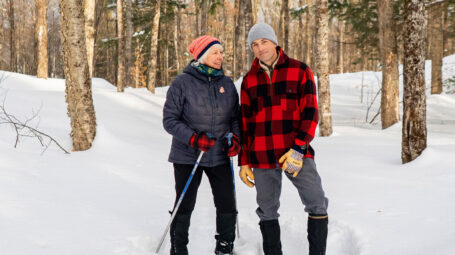
Emily Cayer and Robert Small, spent several hours exploring the 300-acre Northeast Kingdom property they would come to buy. It felt, Emily said recently, “like we had stumbled upon a forest of misfit trees.”  

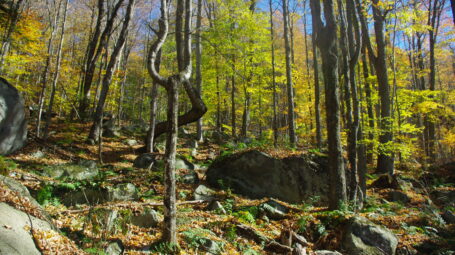
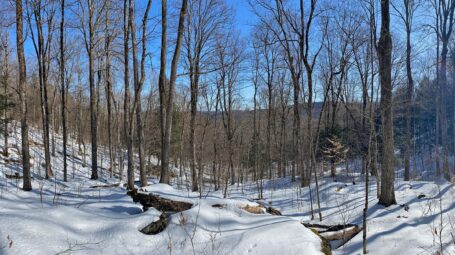
The land had been heavily and unsustainably logged in the past. “The trees that were left behind weren’t good enough for lumber but had gotten damaged by those that had been cut down,” said Emily. Since then, the woods were growing back thick and uniform with saplings, with some scattered larger trees that had been left untouched.  

The opportunity to nurture the forest drew Emily and Robert to the Stannard woodlot. They ended up purchasing the property in 2019 and donating a conservation easement to VLT in 2024.  

“It feels to me like protecting this land through conservation is allowing our misfit forest to heal,” said Emily.  

Hawks, lady slippers, ramps: Uncovering the secrets of the land

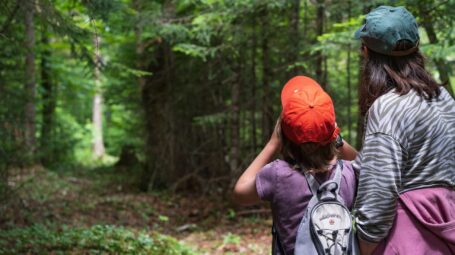
Emily and Robert are self-described nature zealots. Both worked for many years as wildlife biologists, mostly out west, before meeting in Alaska and deciding to relocate to Vermont. They pair scientific curiosity with a strong sense of wonder in every interaction with their land.

“I think about the broad-winged hawk,” said Robert. “We’ve seen them every year, and it’s a big deal when they arrive in the spring. We’ve been interested in finding their nest. We haven’t, and I think that’s the nature of the woods and the forest and critters in general. They always keep some secrets.”

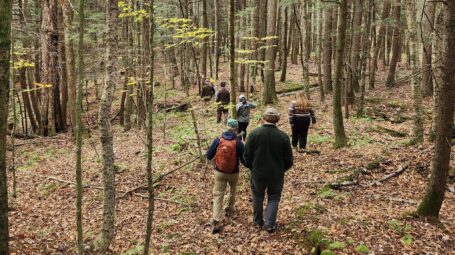
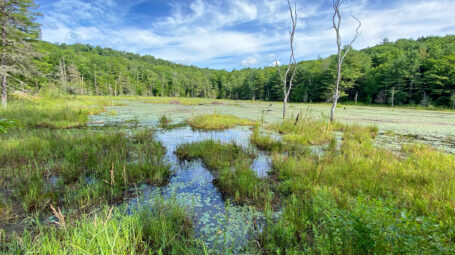
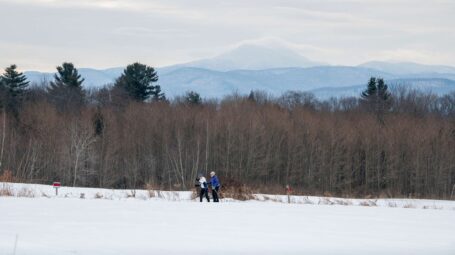
They’ve traversed every piece of the roughly 300-acre parcel, creating nearly five miles of paths they use to watch over and learn from the land. Along the way, they’ve named some of their favorite pieces: the Walking Birch Forest, the Baby Tree Meadow, or Bobcat Cliffs.

But the land still surprises them — with a new tree, or a patch of lady slippers, or new animal tracks. Compared to living out west, both were surprised by how quickly the forest grows each year.

“It used to feel like we were hiking through this wall of young trees, where you just couldn’t see out,” said Emily. “And every year that goes by, it’s like the whole forest is lifting up, and you can see further out when you look around.”
Good stewardship makes good neighbors

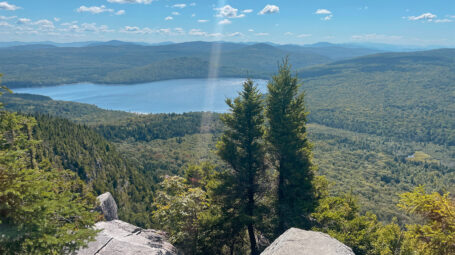
The property is right next to about 11,000 acres set aside for animals — the Steam Mill Brook Wildlife Management Area, owned by the state of Vermont. Tony Smith, who manages the property for the Vermont Department of Fish & Wildlife, said the importance of connected land can’t be overstated.

“Wildlife doesn’t stay in one place,” said Tony. “We can manage our own property to support wildlife, but they are always moving. We need adjoining smaller parcels of privately conserved land to make unbroken pathways for animals to travel.”

Emily and Robert see that movement constantly. They’ve set up five game cameras to observe animal habits. They often track animals while exploring their property, following the signs they leave behind to learn more about their lives.

Sustainable harvests

Given the history of the land, Emily and Robert started out thinking they would not cut any trees. Their perspective began to shift as they built a timber-frame house, and later a timber-frame barn, on the property. Robert, an amateur woodworker, reflected on the trees used to build both frames and in his other woodworking projects.

“It just makes me appreciate that much more what sustainable forestry can be,” said Robert. “All the products that come from the forest feed into the local economy — from the sawmill, to the sawyer, to all sorts of folks that use wood products.”

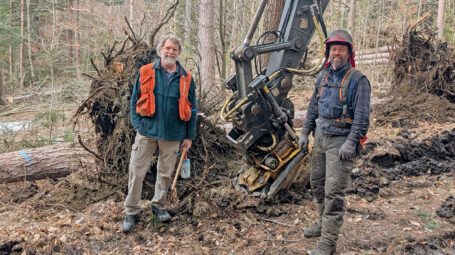
They also sustainably harvest wood for heating. This summer, they worked with John Smolinsky, a horse logger who owns Earthbound Forestry Services, to fell some dead and dying sugar maples for cord wood. Interestingly, John was one of the first people they had contacted in the area, even before they bought the property. “Emily and I had thought it would be interesting to work with him some day,” said Robert, “and that day has come!”

Photo: John Smolinsky of Earthbound Forestry Services, with Emily and Robert standing in the background.

“It’s like a sanctuary”

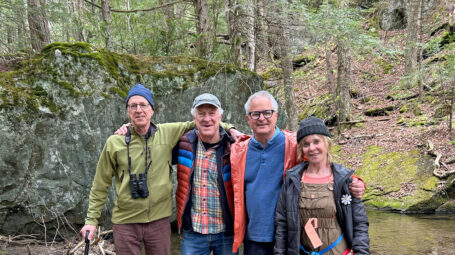
Robert and Emily are working with a consulting forester on an active management plan in keeping with the conservation easement. “My eyes see a wonderful future forest,” said VLT forester David McMath who has spent hours with Robert and Emily, walking their land and discussing its stewardship.

Through it all, Robert and Emily say they don’t feel ownership over the land. They feel gratitude for the opportunity to be stewards of such a beautiful piece of the state.

“It’s like a sanctuary up here,” reflected Emily. “I feel like I’m living in one of the most peaceful places I could have ever imagined. It’s quiet, it’s wild, it’s private. I feel like we’re living with our forest and with our land instead of just on it.”

All photos by Kyle Gray.

“It’s like a sanctuary up here. I feel like we're living with our forest and with our land, instead of just on it.”

Want to support forest stewardship across Vermont?

DONATE NOW