For the love of forests
8 min read / March 6, 2026 / By Laura Hardie
Our website uses cookies to improve your experience. To learn more about how we use cookies, please review our privacy policy.
Can't find what you're looking for? Please contact us.
8 min read / March 6, 2026 / By Laura Hardie
Thousands of land owners and managers across Vermont shepherd forestland conserved with VLT. They each have a unique relationship with the woodlands they tend, and they each shoulder the responsibility and ongoing effort of caring for a portion of Vermont’s vast patchwork of forest.
Crystal Langer and her family are getting to know a wooded Andover property they bought two years ago. She finds that in winter the forest, and its history, come into focus. Stone walls, old fence lines, three-hundred-year-old trees, and animal tracks become part of an outdoor classroom for her nine-year-old son, Oakley.
“My son was asking why certain trees were growing in clusters,” Crystal said. “In the winter, you can really see the bark, the patterns. You start to notice that the way trees grow tells a story about the soil, the water, and the sunlight.” “It felt like the forest was a puzzle we could start to put together,” she added.
“You begin asking questions, ‘Was there a field here before? Why is this one tree 300 years old when everything around it is younger?’ Now we’re always trying to piece together patterns we might not have seen before.”
The Langers are exploring, and stewarding, a 268-acre conserved parcel. They’ve joined thousands of land owners and managers across Vermont who shepherd forestland conserved with VLT. They each have a unique relationship with the woodlands they tend, and they each shoulder the responsibility and ongoing effort of caring for a portion of Vermont’s vast patchwork of forest.
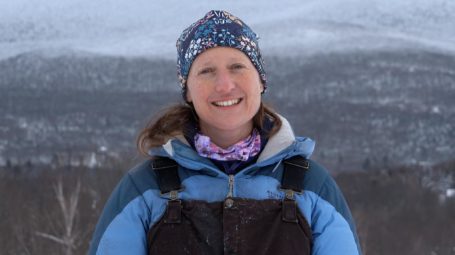
Photo: Crystal and Oakley explore their conserved Andover woodland.
“In the winter, you can really see the forest’s bones,” said Crystal. Winter forests offer something distinctive — place and time to learn, reflect, and find a new perspective.
Daniel Dubie has spent decades walking and hunting in 450 acres of forest in Windham and Jamaica passed down through generations of his family. An ecologist, he has noticed that in the colder months, birds like chickadees, nuthatches, and goldfinches that don’t fly south move together in flocks. They travel communally, passing through, feeding, and moving on.
“If you spend long enough in one spot, they’ll move through the forest, and then you’ll notice the silence return when they’re gone,” Daniel said.
He often closes his eyes and listens as they move through the trees. “It’s a time of meditation for me to be in these woods that I know so well,” Daniel said.
In 2019, while surveying the forest, an adult goshawk dove toward him from its nest, close enough that Daniel dropped to the ground. He wouldn’t see another goshawk there for five years.
By 2024, he was weighing his next steps on a life decision, unsure whether to stay in the region or leave. That winter, a young goshawk landed on a branch at eye level and held his gaze for several minutes before flying off.
“It’s like the goshawk was saying, ‘you’re back,’” Daniel said of his time spent living out west. “It was a reminder that the answer I was seeking is right here in my backyard. Being in the woods helps to work through the anxieties and uncertainties of life that are inherent in our world and ever-changing.”
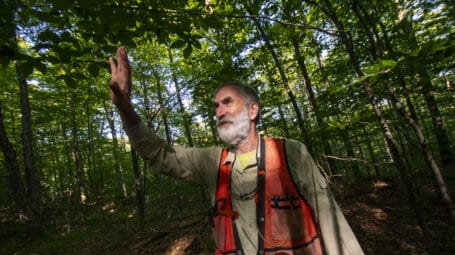
Photo: Daniel Dubie, whose family has stewarded conserved forest in Windham and Jamaica for decades.

More than a hundred miles north, in Woodbury, Cacky Peltz walks familiar paths through evergreen trees to a west-facing outlook to watch the sun set. She turns off her podcast — Peter, her late husband, would want her to listen to the woods, she says with a grin.
Peter bought their first piece of land, now part of their larger conserved 131 acres, in the late 1960s. At first, it was a retreat, a place to camp, then a small, makeshift cabin built with friends. Eventually, with a young child and a desire to start over, Peter and Cacky decided to stay.
As they made their family home there, their belonging — to place and to community — took shape through working the land, especially in winter. Logging, brush hogging, making trails, and harvesting firewood became part of the family’s rhythm.
“Doing wood was a big part of life,” recalled Alex, their grown son.
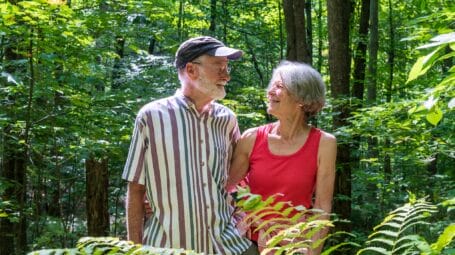
Photo: Cacky Peltz and her son, Alex Peltz, at their conserved Woodbury property.
Alex says he learned the woods the way earlier generations did, harvesting firewood, logging, and clearing trails in winter.
“It almost feels like you’re passing on ancestral knowledge, even if they’re not related to you. It feels continuous with what my father learned from the old timers. Those threads run deep.”
For Alex, that relationship extended beyond appreciation into responsibility.
“It really instilled in me that relationship of not just appreciating the woods but working in the woods and tending the woods.”
That learning shapes how he moves through the land today. Gathering firewood in the winter, Alex finds himself scanning tree health, thinking ahead, noticing what should be harvested and what should be left.
Photo courtesy Cacky Peltz: Family gathered after getting firewood in the 1990s. From left: Todd Wahlstrom, Aysha Peltz Wahlstrom, Cacky Peltz, Peter Peltz, and Alex Peltz.
— Daniel Dubie
As someone who is relatively new to caring for forestland, Crystal is eager to learn. She says she wants to do right by the environment and make sure she follows best practices, but “there are so many opinions about what to do that it can be overwhelming.” So, she’s grateful to be working with VLT forester Pieter van Loon.
VLT’s foresters help owners like Crystal learn about ecological forestry so they can make informed choices.
“It is reassuring to have them on our side, focused on what’s best for the forest,” she said.
“I’ve learned that some practices, like cutting an acre of land, can look gruesome at first, but they help create a new stage of forest growth and bring bird life back into the woods.”
Guidance from foresters about what’s best for the land can sometimes challenge instincts.
Photo: Daniel Dubie (left) in the woods with VLT forester Pieter van Loon (right).
In Woodbury, Alex recalled a time when his father was considering harvesting several large yellow birch trees during a strong market year. Their VLT forester, David McMath, advised against it, explaining the species’ importance to the forest’s structure and long-term health. The trees stayed.
The experience changed how the family thought about timing, restraint, and the role of outside expertise.
Alex also remembers a conversation with David about the way trees die.
“They don’t die all at once,” Alex recalled. “They start to show signs of age and wear and decay, and then it might be several decades before they really start to let go.”
“We have one big old beech that’s still got one live branch,” he added. “And you think… is this a living tree or is this a dead tree?”
The question is an especially poignant one for Alex. His late father, Peter, is buried on the property, in the woods the family worked for decades, and Cacky often visits a nearby bench on her walks.
“I’m glad there are places that are just full of fallen dead trees and shrubs,” added Cacky. “I’m not focused on clearing it up and making it pristine.” Instead, she sees stewardship as “continuing to let this cycle of nature unfold” and remembering that “we are the humans in that cycle.”
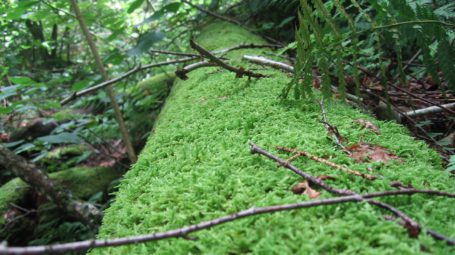
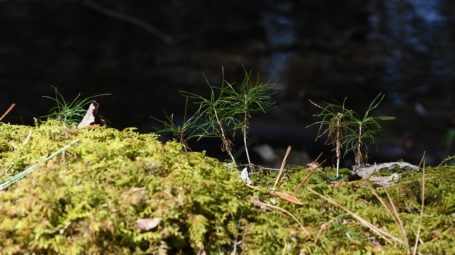
Photo: a long-fallen log covered with moss and the seedlings of new trees, also called a nurse log.
— Crystal Langer
From the moment Crystal and her family arrived at their Andover home, what drew them in wasn’t just the forest — it was the feeling that generations of people had been there.
Crystal has noticed small monuments left by the property’s previous owners — an angel statue along a trail, a plaque in a clearing.
“You start wondering why she chose certain spots,” Crystal said of the former owner. “And then you realize you’re standing where she stood. I imagine her looking out at the view, her mind at ease, and I associate what I’m doing in the woods with what I think she was doing, too.”
She finds herself imagining both directions at once: the people who loved the land before her, and the people who will one day do the same.
As Daniel prepares to help update his family’s forest management plan with his two sons in mind, he’s asking what it means to care for land over time.
He’s keenly aware that the land he walks today has already passed through extremes, clear-cut during colonial times, then allowed to recover.
“When we steward the land, and we take care of it, we’re actually taking care of ourselves, so it’s a full circle, reciprocal relationship,” Daniel said. “By taking care of it, I hope it can be a place for my family to find solace and have their own relationship with it.”
Photo: Oakley Langer with his mother Crystal, puzzling over tree identification.
For Alex and Cacky, the long view is reinforced by granite boulders left behind by retreating glaciers, improbably settled in the woods.
“They really put you in your place,” Alex said. Standing beside them, he’s reminded that the land has been shaped by forces far older than any one family. “To see the reminders of the glaciers, the cellar holes, and logging roads, and appreciate it from that depth — it puts you in a perspective of peace,” Alex said.
“You realize you’re just a passenger here. It’s our property, but it’s not our land. It will be here long after me. That puts stewardship in perspective. It’s humbling, beautiful, and freeing.”
That perspective is shaping how the family approaches stewardship: carefully harvesting firewood, protecting wetlands and beaver habitat, and following a forest management plan that protects the headwater streams of the Winooski River, where cold, clean water gathers before flowing outward.
“Over all these years, those trails are very comforting but also uplifting. You change when you go there; we all have experienced it,” Cacky said. “When you go outside, and you get to a place where you’re surrounded and grounded in the earth, trees, and the animals, you just flush with a new perspective. I find that every time I walk, I see something different.”
Photo: Cacky Peltz
— Alex Peltz
We generally send two emails per month. You can unsubscribe at any time.