Can't find what you're looking for? Please contact us.

Finding their way in Danville

8 min read / September 9, 2026 / By Laura Hardie

A corn maze and a herd of lowline cattle keep a fifth-generation farm in the family

Every November, Mike Boudreau starts designing next year’s corn maze.

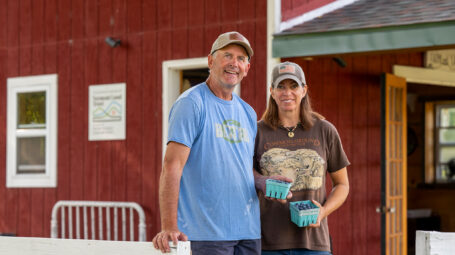
Come summer, he lays it out with graph paper, a seven-foot stick, and a hundred-foot tape measure while his wife, Dayna, directs. Then, he cuts every trail on foot with a 33-inch rototiller. The Great Vermont Corn Maze in North Danville, now in its 28th year, has an underground tunnel and more than a hundred feet of bridges over 24 acres. It also has a following.
Drawing ‘mazers’ to Danville

“I have people who come from many states, a four-hour drive, every year just to challenge me or Dayna. We have third-generation mazers now,” Mike said.

Mike and Dayna were working as physical therapist assistants in southern New Hampshire when they began looking for a way back to the farm where Dayna grew up.

“Nobody else was going to take over the farm. We didn’t want to lose this,” Mike said.

A way to keep the farm: the Great Vermont Corn Maze

The idea came from hosting their young nephews in Vermont for a week each year and “seeing young boys filthy, dirty, sunburned, and just having a great time.”

In 1998, the concept of a corn maze was so new that “in the first three years, we spent a lot of time telling people we were not selling corn,” Mike said.

Today, the maze draws up to 7,000 visitors in a ten-week season. Mike, known as “Mike the Bridge Guy” stands on a bridge in the middle of it all. “I spend the day just surrounded by people laughing, people from different walks of life helping each other solve the maze, sharing water,” Mike said. “We are literally part of people’s lives, and they’re part of ours. It’s these little mini reunions we have every year.”

The maze also helped carry the farm. “The maze is paying for the land at the moment. The farm wouldn’t still be in the family without it,” Mike said. Though, he and Dayna still work per diem in physical therapy. “Without off-farm work, you’re not keeping land in today’s world.”

Researching beef, studying animal science

Dayna’s parents, Roy and Brenda Patterson, milked cows for decades and sold the herd in February 2015, when their grandson Jake was a high school senior. “My plan was to take over the dairy,” Jake said. Then he ran the numbers on what it would cost to rebuild the operation. “Just my two grandparents were struggling to make ends meet on their own.”

Jake spent that spring researching beef. His parents kept showing him a magazine article about Australian Lowline Angus, and he kept brushing it off. “I said, that’s a bunch of pets,” he recalled.

Then he looked closer. “Because they’re a smaller-framed animal, you can put more animals onto the same amount of feed,” Jake said. “You put three lowlines on a plot of land where you’d put two conventionally sized cows, and you come out with a couple hundred pounds more beef in the end.”

In June 2015, his parents bought him a cow and a bred heifer. He studied animal science at UVM, driving home on weekends while his grandfather watched his animals during the week.

Four Town Lowlines beef goes to stores, schools, and senior meals

Today, his grass-fed business, Four Town Lowlines, has about 150 head. Jake processes two beef a month and sells a third to half of it retail from their farm store, along with monthly subscription deliveries across northeastern Vermont.

He wholesales to Buffalo Mountain Market Co-op, and through the Vermont Farm Direct program with Green Mountain Farm to School, his ground beef reaches area schools and a Meals on Wheels senior meal site. This year he is trialing pigs and pastured chickens.

“It’s an investment to get into beef,” Jake said. “To start making any money out of it, you’ve got to keep a cow for so many years, but during each of those years, you’re still going to pay to feed them.” After a decade of reinvesting, “we’re about ready to step over the line,” and he has his sights on doubling the business.

A secure future on secure land

Land made it possible. In 2021, Dayna’s father conserved 134 acres of farmland and woods and this past year the family conserved 39 acres they had leased for years and recently bought. On both occasions, conservation funding helped the family secure land for farming — the Pattersons were able to pass the family land to the next generation, and buying additional land for the farm operation became more affordable.

“A big thing with grazing is graze it quick and then let it rest for a long time. To do that, you’ve got to have land to move the cows through,” Jake said. “Having something like this program [conservation] makes it more attainable to afford land. It’s helped make the future a little more secure.”

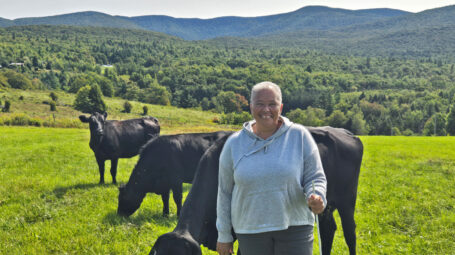
Photo: The fourth and fifth generation on the land, Roy Patterson (left) and his daughter, Dayna Boudreau.

A sixth generation on the land

The family used to require each generation to work off the farm for two years before coming back. They broke the rule for Jake so he could learn from his grandfather, who is 75 and still working beside him. “Now he’s had ten years of grandpa, learning everything,” Mike said. “It’s worked out really well, and it’s kept him young, I think.”

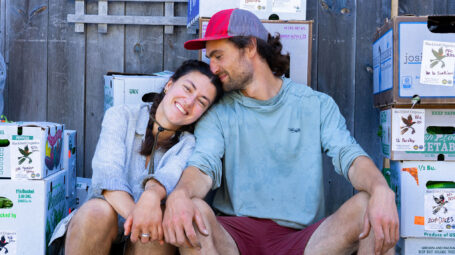
A sixth generation is already out on the land, too. Jake and his wife, Ali, a veterinarian, have a one-year-old daughter who rides in a backpack most days while he does chores. “If I don’t take her outside,” he said, “she throws a fit.”

Photos by Kyle Gray.