Can't find what you're looking for? Please contact us.

South Burlington farmers unite for community and sustainability

9 min read / November 11, 2025 / By Laura Hardie

Shared land, shared lives

On the southern edge of Vermont’s busiest county, just six miles from Burlington, a handful of neighboring farms and farm-based businesses have chosen an unfamiliar path: instead of competing for customers, land, and resources like equipment, they have decided to build something together that could outlast them all. 

This story is part of our 2024-2025 Annual Report. Read more about the places and people we worked with here.

They call it The Agrihood Collective or TAC. It’s a farmer-led nonprofit that owns conserved land in South Burlington and leases it back to mission-aligned farm businesses. It’s a simple idea with lasting benefits: give farmers the long-term security needed to farm sustainably.

“What TAC is able to do,” says founding member and farmer Brandon Bless of Shelburne-based Chrysalis Landworks, “is take the speculative real estate market off of the land in perpetuity to create affordable long-term land access.”

For working farms, that shift changes everything. Instead of feeling hesitant to invest in the land due to a short lease, farmers can plan on a decade or more — planting orchards, installing infrastructure like irrigation, building agroforestry systems, and investing in soil health they know they’ll be around to benefit from.

“You get time security and financial security,” Brandon adds. “It lets you do your best work for the land and the farm business.”

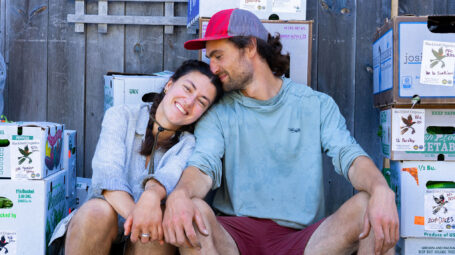
Header photo: L to R, Brandon Bless, Breana Killeen, Kieran Killeen, and Corie Pierce of The Agrihood Collective, South Burlington

Healing land, living in balance with ecosystems

The land under the Collective’s care needs that kind of patience. Founding member and farmer Corie Pierce of Bread & Butter Farm recalls, “When we began managing the property, the soils showed the wear of many years in intensive hay.” Like much farmland that has seen decades of the same crop, the clay soils were compacted and in need of renewal. Still, its location made it compelling.

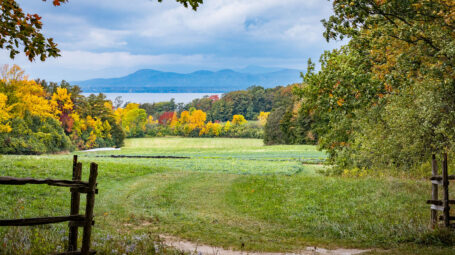
The 360-acre property, known locally as the Auclair Farm after the family that cared for it for generations, sits close to Bread & Butter’s existing 143-acre beef, pig, and organic vegetable operation straddling South Burlington and Shelburne, and neighbors other farms. It’s also near Vermont’s largest population center. The Collective saw an opportunity worth the effort.

They have since poured resources into the land. With support from USDA’s Natural Resources Conservation Service, Vermont Agency of Agriculture, and Vermont Housing & Conservation Board, they’ve installed fencing and water systems and plan to plant thousands of trees in agroforestry systems. “We’re basically in the mode of trying to build soil health,” Corie says.

Making a sustainable living with the land

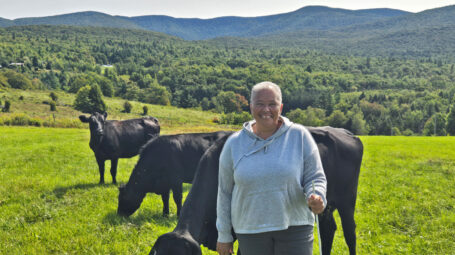
Cattle are now grazing much of the acreage (riparian areas excluded), and the farm businesses associated with the Collective are planning for diversified rotations with sheep, poultry, and pigs as the soils rebound and once infrastructure is in place.

The goal is to make a sustainable living with the land, Corie says. “Success is recognizing humans are intrinsically part of the natural world. We can make a living in balance with these ecosystems, and support many families, without extracting.”

In addition to Brandon and Corie, the Collective’s board includes Mike Proia of the Blank Page Café co-located at Bread & Butter Farm, Kieran and Breana Killeen of the neighboring Killeen Crossroads Farm, and V. Ernesto Méndez, Co-Director of the UVM Institute for Agroecology.

When TAC bought the land, it inherited the pre-existing land lease to Bread & Butter Farm who had been farming the land since 2018. Because the land is conserved and held by a nonprofit, leases are structured to be affordable, long-term, and renewable, giving farm and food businesses the security to invest in systems that endure.

Conservation: a base layer for innovation

Conservation is the quiet backbone of this story. Starting in 2017, when the 360-acre parcel went up for sale, VLT began working with the farmers behind TAC, conservation partners, and funders to protect the land. Over several years and across multiple transactions, VLT purchased and then conserved more than 360 acres of farmland, wetlands, and streams.

This created the “requisite base layer,” as Brandon says, that made so much more possible. “VLT has done some amazing work in terms of bridge financing to make our project happen; that was a huge missing link.” Without that, he explains, “this organization [TAC] wouldn’t exist. It wouldn’t even be conceived of because no one would believe it was remotely possible.”

In 2025, after running a successful community fundraising campaign and establishing a nonprofit, TAC took ownership of the land. “With conservation, this became possible,” Brandon says. “It’s the platform that lets us ask, ‘How do we evolve from this gift that is a conservation easement? What else is possible now?’”

What becomes possible

The answer: shared infrastructure and housing designed for farm life.

Alongside the conserved acreage, TAC acquired a small, 13-acre parcel outside the easement specifically to support the people and logistics that keep farms running. Their vision is to establish affordable housing, shared cooling and freezer space, a commercial kitchen, a cooking school, and a community marketplace. Together, these investments will create a hub where farmers can prepare, store, and sell their products while offering education to the community.

“There’s nearly 400 acres here,” Corie says. “We need some of it for housing, and some for a market hub and shared infrastructure. If we want more people to make a living here, the place has to function for them.”

The non-conserved piece was the hardest and most expensive to secure, she notes, but it’s essential: without affordable housing located nearby and common workspaces, farms lose time, staff, and momentum.

Collaboration, not competition: A bold vision for secure land access and farm housing

Stacy Cibula, Agricultural Director at the Vermont Housing & Conservation Board (a key funder for the land’s conservation), sees TAC’s model addressing some of Vermont’s most pressing farm challenges.

“Rising land costs and short-term leases are among the biggest barriers farmers face,” she says. “When you strip away development rights and create long-term ground leases, you’re opening the door for people to invest in their businesses and their land.”

She also points to TAC’s focus on people and infrastructure. “We hear all the time that there’s not enough affordable housing for farm workers. Having the housing piece has always been a crucial part of it,” she says.

And in a county where many food businesses sit within a few miles of each other, the farmers’ choice to collaborate stands out: “Rather than competing in a tight market, they asked, ‘What can we create together?’ That’s impactful.”


Looking ahead

Looking ahead, the Collective plans to identify aligned businesses interested in leasing and is exploring how lessees might one day apply to TAC itself for lending opportunities — another way to lower barriers for farmers.

They’re also working with area towns to create up to 14 miles of new public recreational trails that connect the land to other conserved properties.

None of the work, Corie says, is about short-term gain.

“None of us are doing this just for our own careers,” she says. “We want healthy land, healthy communities, and healthy ecosystems for the generations that follow.”


Photo: L to R, Breana Killeen, Brandon Bless (seated), Corie Pierce (with hat), and Kieran Killeen (seated, far right).

All photos by Caleb Kenna.

“Success is recognizing humans are intrinsically part of the natural world. We can make a living in balance with these ecosystems, and support many families, without extracting.”

Want to support farmland access across the state?

DONATE TODAY