Can't find what you're looking for? Please contact us.

Collecting seeds can help ash trees survive for the future

7 min read / June 1, 2026 / By Sarah Wolfe

Emerald ash borer is here

The invasive insect was first identified in the United States in Michigan in 2002. Wherever it spreads, ash trees decline. In some forests, losses are staggering. And yet, the insect doesn’t kill every ash tree it encounters. That means there is still hope for the three native ash species in Vermont.

Ash trees, particularly black ash, are both culturally and ecologically vital to Vermont. While we cannot reverse the spread of the emerald ash borer, a coordinated effort can ensure that ash species remain a part of Vermont’s forests for generations to come. Collecting and storing ash seeds this year is an important part of that strategy.

What does survival look like for ash trees?

Vermont is home to three native ash species: white, green, and black (or brown) ash. All are threatened by the emerald ash borer. As the insect tunnels beneath the bark, it disrupts the tree’s ability to move water and nutrients, weakening the tree.

But widespread loss does not have to mean total loss. Many public and non-profit partners and landowners are working hard to sustain ash for the future. A coordinated, multipronged approach can ensure that ash survives.

“Emerald ash borer doesn’t mean the end of ash in Vermont,” says Caitlin Cusack, VLT Forester. “It challenges us to think generationally about the health of our forests and our diverse ecosystem.”

Photo: A stand of black ash trees, taken by Brooke Fleischman, Intervale Conservation Nursery.

Across Vermont, organizations and landowners are working together to:

  • Retain a range of healthy ash in the woods
  • Encourage natural regeneration
  • Introduce biocontrols (natural predators for the insect)
  • Breed trees that may have resistance
  • Protect small batches of seed trees through insecticide treatments
  • Collect seeds to safeguard genetic diversity

This summer, a group of organizations will launch the first large-scale black ash seed collection effort in Vermont.

Photo: Members of participating organizations at a spring training focused on seed collection, taken by Jess Colby, NorthWoods Stewardship Center.

“Emerald ash borer doesn’t mean the end of ash in Vermont. It challenges us to think generationally about the health of our forests and our diverse ecosystem.”

Collecting seeds to preserve a species

This year, Smokey House Center is leading Vermont’s first coordinated ash seed collection effort, in partnership with VLT, NorthWoods Stewardship Center, Intervale Center, Vermont Department of Forests Parks and Recreation, Stowe Land Trust, Ecological Research Institute, and The Nature Conservancy. Additional partners and individuals will help with collection efforts this fall.

“When we collect seeds, we aren’t saving the tree today,” says Rose Gellman, former Smokey House Center Forest Programs Coordinator who helped catalyze this effort, “We are saving the potential of a future tree, a future diversity of trees that can adapt to survival in future forests.”

Photo: Participating organizations learn how to use “big shots,” giant slingshots that shoot a line over the top of the tree. Tarps spread underneath the tree will catch seeds as the line is pulled down. Photo taken by Jess Colby, NorthWoods Stewardship Center.

Like many trees, ash go through reproductive cycles. When conditions are right, trees will have a “mast year,” or a year in which seed production is significantly higher than in recent years. Experts predict 2026 could be the start of a mast year for black ash trees, given the last large seed year was 2022.

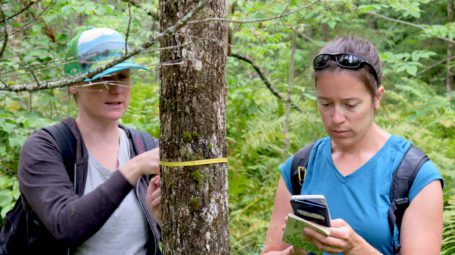
Teams from Smokey House Center, NorthWoods Stewardship Center, Intervale Center, Vermont Forests, Parks & Recreation, and VLT will visit sites across the state to assess the health of identified ash trees. In the fall, they will return to collect seeds from confirmed, healthy females. Intervale Center will then prepare and ship the seeds for long-term storage, preserving genetic material that could one day help restore ash to Vermont’s forests.

The effort will focus on black and green ash. These species are less common and more vulnerable to emerald ash borer.

Photo: On the left, black ash seed clusters. On the right, green ash seed clusters. Both taken by Brooke Fleischman, Intervale Conservation Nursery.

Ash trees play an integral role

Ash trees help shape forest ecosystems. Nearly 100 invertebrate species specialize in feeding on North American ash trees. About one third of those species are moths, many of which have been designated as high risk due to their dependence on ash. Growing in or near wetlands, green and black ash drop leaves that provide an important food source for tadpoles and caddisflies and enrich the soils with nitrogen and phosphorous. In wetlands, black ash helps regulate water levels, moderating flooding in the watershed.

Black ash also carries deep cultural significance to some indigenous people. The Abenaki believe they first emerged from a black ash tree. Today, black ash strips are the primary material for traditional basketry.

Photo: A black ash tree rising from the forest, taken by Brooke Fleischman, Intervale Conservation Nursery.

Identifying ash trees

An ash in the forest

Ash trees can be identified by their leaves and branching pattern. Ash trees have compound leaves; a central stalk connects five to nine leaflets. The trees grow in an opposite branching pattern, meaning the branches grow across from each other. (Maple trees also have an opposite branching pattern.)

Photo: A white ash tree trunk, showing the opposite branching pattern.

White, green, and black ash

Not sure what species of ash you’re seeing? The best clue is the landscape around you. White ash is the most common of the three native species in the northeast. While white ash likes moist soils, green and black ash prefer wet soils. Green ash is often found in floodplain forests, while black ash likes to grow in forested wetlands, tolerating saturated soils for at least part of the year.

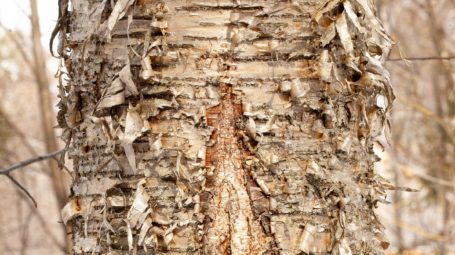
While the tree’s location provides the best information for identification, the bark can also reveal clues. Mature white and green ash trees have deep diamond-shaped fissures. Black ash trees have rough, corky bark.

Photo: On the left, black ash bark, taken by Brooke Fleischman, Intervale Conservation Nursery. On the right, white ash bark, which looks very similar to green ash bark. 

Female and male trees

Did you know ash trees are either female or male? Male trees fertilize female trees, which produce seeds. A single female needs 6-12 surrounding male trees for fertilization. The best way to tell the sex of a tree is to observe it in seed season, starting in June through the fall.

Photo: A cluster of ash flowers on a female green ash tree, taken by Brooke Fleischman, Intervale Conservation Nursery.

Header photo: Black ash tree flowers, taken by Jess Colby, NorthWoods Stewardship Center.

Pull quote photo: Black ash trees from below, taken by Brooke Fleischman, Intervale Conservation Nursery.

How can you help?

Seed collection is one way Vermont is protecting and preserving the future of ash.

Are you a landowner? Do you think you have black ash growing on your land? Please fill out this form to report black and green ash for seed collection.

Report Ash Trees (opens in a new tab)