Q&A: How we conserve land
5 min read / September 23, 2026
Can't find what you're looking for? Please contact us.
5 min read / September 23, 2026
How do we approach the work of protecting land?
We asked Britt Haselton, who has worked in conservation science and land protection for two decades, including the last 14 years at VLT where he started out managing conservation projects and now leads our conservation easement program.
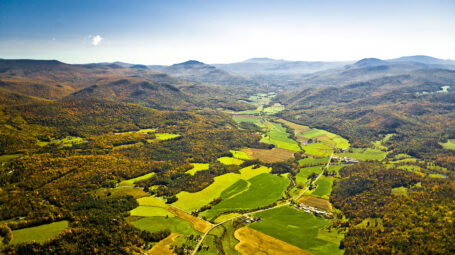
Britt: Land is the platform for so many things that livable and resilient communities need. People need developable land for housing, healthcare, and commerce. We also need, and value, forests that are healthy and intact, farms that grow food, and community-owned lands that safeguard our state’s incredible recreation opportunities. Increasingly, we also need to restore watersheds to improve water quality and flood resilience.
The reason I love working at VLT is that we strive to protect places that matter for people who live, work, and depend on the land, and that provide significant public and ecosystem benefits. Of course, there are plenty of places where conservation isn’t the right vehicle for what a community wants or needs. Our role is to balance a wide range of priorities for the best possible outcome. For example, we can help communities acquire private forestland and create a new town forest — like the Monkton Town Forest, with trails and public access. That’s an amazing outcome we can foster.
Britt: VLT’s conservation work is always voluntary and in many ways led by the property owners who approach us. We couldn’t do any of this work without willing landowners and communities that want to pursue conservation. The conservation easement, which is our primary tool for land protection, is a legal agreement between landowners and VLT that protects land for farming, forestry, nature, clean water, and/or recreation. This voluntary approach is a big reason we’ve collectively achieved such a lasting impact across the entire state.
The conservation process also involves town selectboards, planning and conservation commissions, and funding sources that have their own eligibility criteria for which projects they will support. Every project decision is made in partnership with local partners and town zoning plans. That’s where having our experienced local staff on the ground is really helpful. We look at opportunities, evaluate the possible outcomes of conservation, and assess whether we can achieve those goals with community partners and available resources. Then we work with landowners, communities, and funders to actually get it done.
Britt: When an opportunity comes up, we evaluate the resources that can be protected forever, whether that’s prime agricultural soil or forest connectivity or a healthy watershed, and how that aligns with the landowner’s goals. Then we look at wider community needs, like public trail access and climate resilience. We also consider whether the project fits within Vermont Conservation Design, a science-based framework, developed by the state and conservation organizations, that identifies ecologically important areas to help prioritize the use of public resources.
If there are significant conservation values that can be protected or enhanced, then we start thinking about project feasibility. Can we protect or enhance conservation values with a legal easement? Does land conservation make sense, given the landowner’s goals and surrounding context? Would the project align with local and regional planning efforts? And can we obtain funding to do it?
The ultimate decision to conserve is never VLT’s alone. We are only one of the decisionmakers. It begins and ends with the people — individuals, families, communities — who want to conserve their properties.
Britt: One misconception is that VLT is opposed to development. When VLT looks at a potential project, our focus is on the property owner’s goals, the natural resources, and the outcomes we can support; not stopping a development. We rarely pursue projects in more dense areas — for example, in or near a village center — unless there is strong support and desire from the local community. Vermont needs both development and protections for natural resources that provide public benefit.
Second, there’s less awareness that our project selection is systematic and thorough. One reason might be that the types of projects we work on have evolved over time. That shift is intentional and in response to changing public needs and desires. The impacts we are trying to achieve today are different than they were when we started doing this work in 1977. Climate change, flood resiliency, housing needs, changes in commercial agriculture — all of these things and more influence which projects we decide to work on, and why. There are always a lot of factors that go into project selection and we take time to be thorough and deliberate, and to consult and collaborate with other stakeholders and funders.
Britt: A year ago, we were wondering if the federal funding for farmland conservation would be gone. That resource is critical for about half of all easement projects we do each year. For now, that funding is secure, but it’s one of many external factors that influence our work. So a big thing at VLT is staying nimble.
But VLT’s nimbleness is always in the context of the long view. After all, our work is the long view: the land we conserve today is what we will help steward into the future. Our work evolves in response to changing public needs and desires, as well as evolving knowledge of ecosystems and natural processes. Flood resiliency is a great example: we have thousands of conserved landowners we can now ask, “Do you want some help restoring your river buffer, or retiring your wet field that’s not very productive?”
The goal is always to improve outcomes — for people, for wildlife, for forests, for rivers and streams.
As our Conservation Director, Britt helps lead our easement conservation work in terms of policy, external relations, and support for our internal team. Britt joined VLT in 2012 after working on a variety of conservation science and land protection projects in Vermont and New York. He lives in Bolton with his wife and two kids.
EmailAs our Conservation Director, Britt helps lead our easement conservation work in terms of policy, external relations, and support for our internal team. Britt joined VLT in 2012 after working on a variety of conservation science and land protection projects in Vermont and New York. He lives in Bolton with his wife and two kids.
Email