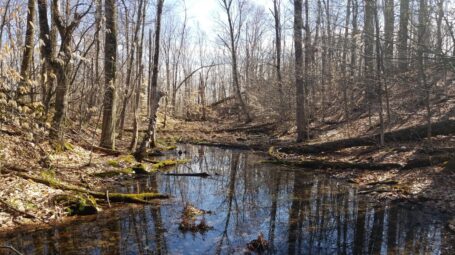
Riparian forests, the forests that line streams and rivers, are critical for preserving water quality and aquatic habitat in Vermont’s streams, providing wildlife habitat, and slowing floodwaters. But most of our understanding of riparian forest ecology is based on second growth forests that have regrown following 19th century clearing for agriculture. Old-growth riparian forests provide in-stream habitat features that have not been widely recognized in the eastern U.S.

Join Allaire Diamond, VLT’s Ecology and Restoration Program Director, to learn about VLT’s approach to conserving and restoring riparian forest and Bill Keeton, Forest Ecologist and UVM Professor in the Rubenstein School of Environment and Natural Resources, who will share 20+ years of research across northern New England on old-growth riparian forests. You’ll learn how enhancing late-successional forest characteristics in stream corridors can store carbon and improve instream habitat structure and complexity, particularly along headwater streams. It may also contribute to downstream nutrient pollution reduction, although this remains the topic of ongoing research. Carefully managing, conserving, and restoring structurally complex riparian forests are exciting tools that VLT and our research partners hope to use across Vermont’s watersheds in the coming years.

This webinar is approved for 1 CFE/CEU.

The Vermont Land Trust welcomes all people regardless of background or identity.